The focus of this check isn't whether the cap fits or how the fabric feels; it's confirming whether the packaging method, package volume, and billing rules change the final amount due when one Corteiz adjustable baseball cap is shipped in a combined package. Current product evidence comes from a Fashionreps QC page. The page title points to a Corteiz black baseball cap, but the page text includes both "Corteiz black trendy ve
The focus of this check isn't whether the cap fits or how the fabric feels; it's confirming whether the packaging method, package volume, and billing rules change the final amount due when one Corteiz adjustable baseball cap is shipped in a combined package.
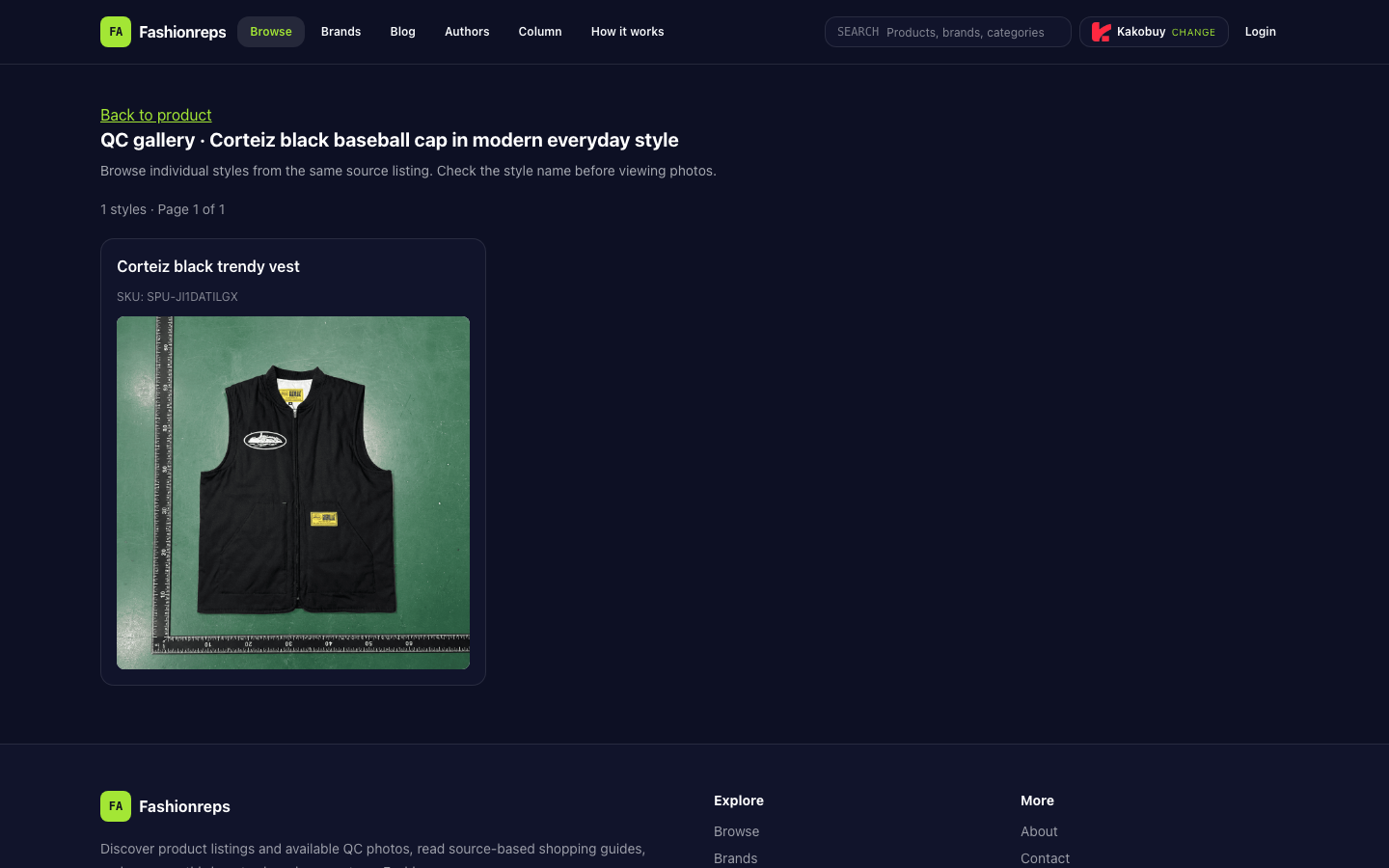
Current product evidence comes from a Fashionreps QC page. The page title points to a Corteiz black baseball cap, but the page text includes both "Corteiz black trendy vest" and a corresponding SKU, so the specific product variant can't be confirmed from this page alone, nor can price, stock, weight, or shipping costs be inferred from it. Before checking costs, you need to complete the product identity and package records.

First Confirm the Product and Packaging Status
Before getting a combined package quote, record the following:
- Product name, color, adjustable style, and the variant name shown on the platform.
- Product link or order number, and the time of inquiry.
- Whether it comes with a hat box, cardboard box, hang tags, plastic bag, or extra padding.
- Whether the current record is the single item as received in the warehouse, or the package after it's been packed.
- Whether the QC page product exactly matches the cap in your order.
The cap itself is usually not the only variable in cost verification. If you keep the hat box or add protective materials, the package dimensions might change; but without actual packed dimensions and the agent's billing rules, you can't directly claim it will definitely increase costs. Use the warehouse weight, packed dimensions, and the amount shown at checkout as the source of truth.
Break Down Costs into Separate Fields
Don't just save a single "combined package total." Record the item price, service fees, payment fees, packaging fees, international shipping, exchange rate, and any surcharges separately. That way you can tell whether the final amount changed due to volume, packaging, or something else.
| Field | What to record | What to check |
|---|---|---|
| Item price | Order amount for the cap and currency | Don't combine item price with shipping |
| Service fee | Agent's purchasing, storage, or handling fees | Confirm if calculated per order, item, or package |
| Payment fee | Fees from the payment channel and currency | Note if it's a percentage |
| Packaging fee | Cost for reboxing, reinforcement, removing the box, or other packaging services | Confirm it's a service you selected, not an assumption |
| Package info | Length, width, height, actual weight, and chargeable weight | Distinguish between single item, combined package, and after repacking |
| International shipping | Shipping route, destination, chargeable weight, and quoted amount | Record the time of inquiry and quote validity |
| Exchange rate | Rate used for settlement or converted amount | Don't substitute with non-settlement rates from search results |
| Surcharges | Remote area, fuel, oversize, or other fees | Only record if shown at checkout or stated in rules |
The final amount due should be broken down according to what the page actually shows, not reverse-engineered from the cap's estimated weight or typical shipping costs. The current materials don't provide specific prices, packaging fees, package dimensions, actual weight, chargeable weight, destination, or real-time settlement amount, so no monetary examples are given here.
Check Volume-Based Billing Separately
When combining packages, save at least two sets of package records: shipping separately and shipping combined. For each, record actual weight, dimensions, chargeable weight, shipping route, destination, time of inquiry, and a screenshot or text of the quote page.
Focus on these relationships:
- When shipped separately, does the cap use a hat box or other rigid packaging?
- After combining, is the cap placed into a larger outer box?
- Does the agent use actual weight, volumetric weight, or the greater of the two?
- Are the volumetric weight calculation unit, conversion factor, and rounding method clearly stated in the current route's rules?
- After combining, do any oversize, minimum chargeable weight, or route-specific conditions apply?
- Does the chargeable weight shown at checkout match the warehouse record?
If the page only shows a package total without dimensions, weight, or billing rules, you can only record the "quote result," not determine whether the increase is due to volume. In that case, don't attribute the price change to the hat box or packaging materials.
Record Packaging Fees and Volume Fees Separately
Packaging fees are charges for packaging services provided by the agent, while volume fees relate to package dimensions and route billing rules. They may appear together or separately.
Follow this sequence when checking:
- First save the warehouse weight and outer packaging info of the unprocessed package.
- Check if you selected services like box removal, reboxing, reinforcement, or other packaging.
- After combining or repacking, save the new length, width, height, and weight.
- Get a quote for the same destination, route, and similar time.
- Check if the checkout details list packaging fees, handling fees, and international shipping separately.
- If repacking incurs new charges, save the confirmation page or service record.
If you changed only the packaging service but also switched shipping route, destination, or settlement currency, the before/after amounts can't be compared as a single variable. Mark these changes separately; otherwise, you can't tell which factor truly affected the final amount.
When to Compare Separate vs. Combined Shipping
Comparison is meaningful only when the conditions of the two records are close enough. At minimum, the destination, route, currency, and inquiry time should be comparable, and the item list should be unchanged.
Use this decision order:
- If both records provide actual weight, package dimensions, chargeable weight, and full cost breakdown, you can compare packaging and volume changes.
- If only the total shipping cost is available without chargeable weight or route rules, you can compare final quotes but not explain the reason.
- If the combined record lacks dimensions or weight, get the warehouse data first before deciding to compare.
- If the product variant or packaging status is unconfirmed, stop drawing cost conclusions to avoid using a wrong product's QC record as cap evidence.
- If the checkout page has no real-time amount, you can only build a list of missing fields, not output a definite savings or increase amount.
What Can Be Concluded from Current Evidence
Current materials only confirm that the Fashionreps page provides a QC page entry related to the Corteiz name, and that the page contains inconsistent product information. No prices, stock, shipping costs, packaging fees, destinations, weights, or dimensions are provided, so it can't be confirmed whether combined shipping is definitely more expensive, or whether the hat box necessarily triggers volume-based billing.
When actually verifying, the most reliable method is to put product identity, packaging status, package dimensions, actual weight, chargeable weight, and each fee into one checklist, and keep the inquiry time. If any key condition is missing, limit the conclusion to "pending confirmation from the checkout page or warehouse record" instead of using estimates in place of actual amounts.
Nadia Brandt is the site's Editor-in-Chief, reviewing important corrections and leading its quarterly shipping-line timing study. Her coverage includes shopping-agent fee structures, parcel consolidation and volumetric weight, EU-bound shipping timelines, personal-import customs paperwork and QC photo interpretation. Each quarter, she sends paired 2 kg and 5 kg test parcels along every line the desk covers, logging pickup scans, warehouse departure, airline departure and delivery dates against the date the quote was issued. She reconciles the parcels with agent invoices, records cost differences, and uses median figures for the site's public timing tables. She maintains the order log in which scores are fixed before page performance is checked. Her coverage explains the transport milestones and invoice checks behind comparisons of shipping times.