Start with what's known about these shoes The page lists these gray two-strap slides as having a soft leather upper, a cork-rubber cushioned midsole, and a lightweight EVA outsole, with sizes marked EU 34–45, and the page individually lists 35–40. The page's reference price is $22.39; the final item price, service fees, and international shipping need to be confirmed with the shopping agent platform, and you can't judge the total cost based solely on the reference price. 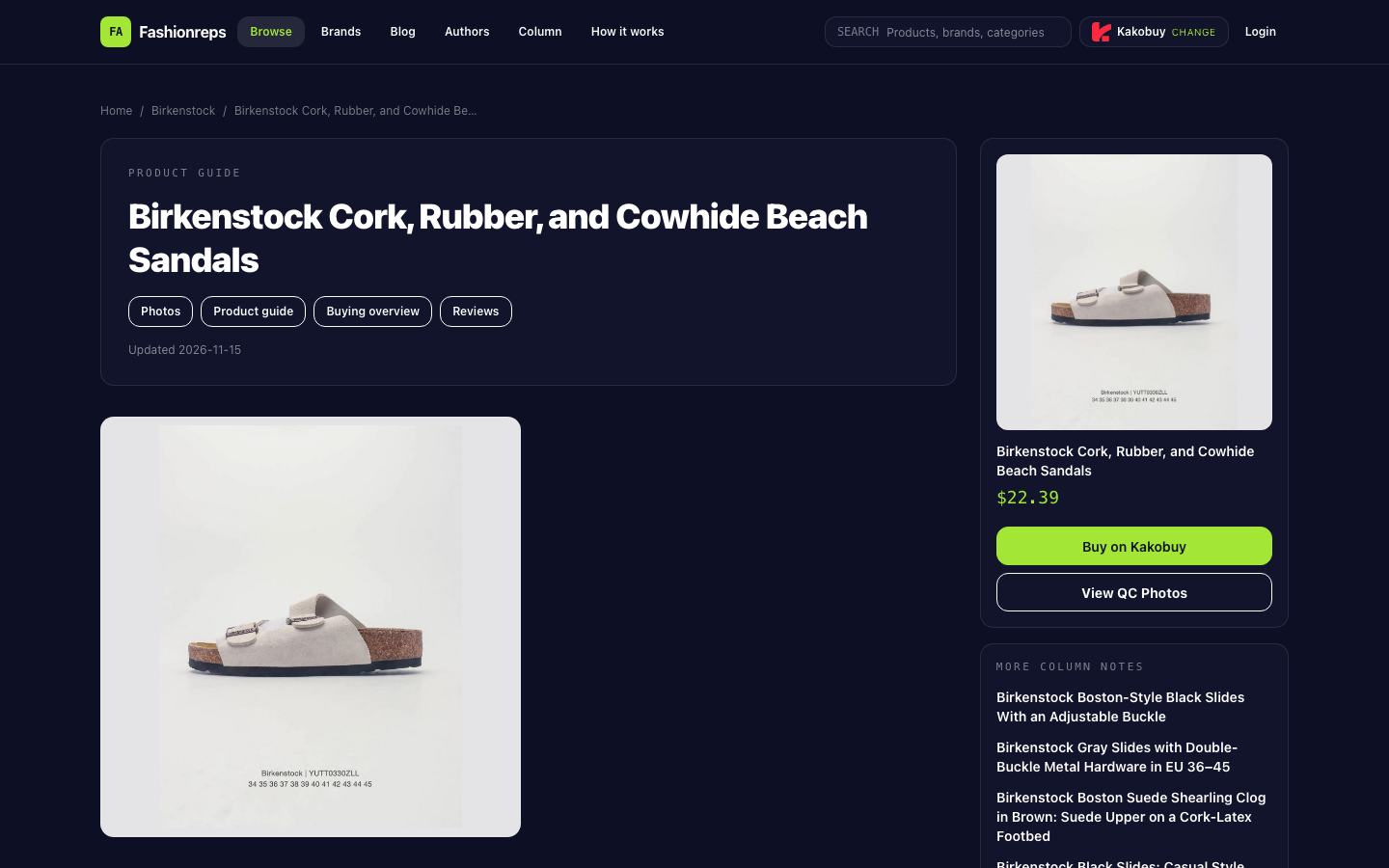
Start with what's known about these shoes
The page lists these gray two-strap slides as having a soft leather upper, a cork-rubber cushioned midsole, and a lightweight EVA outsole, with sizes marked EU 34–45, and the page individually lists 35–40. The page's reference price is $22.39; the final item price, service fees, and international shipping need to be confirmed with the shopping agent platform, and you can't judge the total cost based solely on the reference price.

This content addresses only one issue: whether the footbed length and arch position suit your foot shape. The page materials don't provide actual footbed lengths for each size, nor do they show a size chart with per-size measurements you can check, so I can't directly assign you a specific EU number.
When choosing a size, measure foot length first, then check toe room
Stand barefoot with your heel against a wall and mark the position of your longest toe on paper. Measure left and right feet separately and record the longer one. Keep your body weight naturally distributed when measuring, because sitting down can underestimate foot length.
Then ask the seller for the actual footbed length of the target size and request the measurement method. The key isn't just looking at the external upper length, but confirming the usable length from heel to front edge of the footbed. Once you have that data, you can judge in this order:
- Use the longer foot's length as the baseline, not just your usual sneaker size.
- Confirm there's still moderate room in front of your toes; the longest toe shouldn't touch the front edge of the footbed.
- Avoid choosing too short just for a snug fit. When the footbed is too short, toes and forefoot easily press against the edge, and the arch contour may not sit in the right place.
- If your feet differ in length, prioritize that the longer foot fits naturally, then consider whether the shorter foot needs adjustment via straps, socks, or other means. The two-strap design can adjust the hold, but it can't make up for insufficient footbed length.
The page's Arizona style reference suggests leaving about 0.5–1 cm in front of the toes. This value can serve as a preliminary guide, but it's not a measured size chart for this specific product. Ultimately, you still need to compare the target size's footbed length against your standing foot length.
Arch position matters more than "can you get your foot in"
After putting them on, don't just judge whether your foot fits inside. Stand and observe the relationship between your sole and the footbed, focusing on whether the arch support contour sits under your arch, rather than pressing against the front or back of the arch or shifting noticeably inward or outward.
Check three positions:
Clearly suitable means your heel sits stably at the back, your forefoot isn't squeezed to the front edge, and the arch contour is under the middle of your sole. The two straps mainly secure the foot, and you don't need to constantly curl your toes to hold position.
Caution needed means the length seems enough, but the arch bulge clearly presses where your foot isn't used to it, or your foot keeps sliding forward when walking. Simply tightening the straps doesn't change the footbed's support structure position.
Not suitable to guess further means you can't simultaneously satisfy heel position, forefoot room, and arch placement. At that point, prioritize getting a side profile diagram and footbed length for that size rather than blindly choosing between adjacent sizes.
What to ask the seller before buying
If the page doesn't provide detailed measurements for the target size, focus your questions on verifiable data:
- Actual length from the back to the front of the footbed for the target size, noting whether it's measured along the footbed.
- Width at the widest part of the footbed, especially useful for wide forefeet or noticeable left-right differences.
- Side-view photo of the target size to see the cork-rubber midsole's arch contour and height changes from front to back.
- Photo of the gray upper in natural light to judge whether the color and finish match the page display.
- Adjustable range of the two straps on the target size, and whether the strap hole positions match your instep height.
These items correspond to four checkpoints: length, width, arch, and appearance. If the seller can only provide generic product images and can't provide the target size's footbed length, you can only do a preliminary screening and shouldn't state the sizing judgment too definitively.
Which foot types should choose sizes more conservatively
If your foot length is near the boundary between two sizes, first compare the actual footbed lengths of the two sizes rather than directly relying on experience with other brands. If you have a high instep, also pay attention to strap adjustment range; if you loosen the straps a lot for instep comfort, your foot may slide back and forth on the footbed.
If you have a wide forefoot, besides overall footbed length, ask about the width at the widest point. Length fitting doesn't mean forefoot space is adequate. If your toes are forced together, continuing to go up a size may also cause the arch position to shift, so width data is more useful than simply moving to a larger size.
If one foot is noticeably longer, first check the footbed against the longer foot, then check whether the shorter foot slides when worn. The two straps only improve the hold, not substitute for correct footbed length.
Usage scenarios should match this type of construction
The page describes them as beach sandals and lists a cork-rubber midsole and EVA outsole. What's confirmed here is material and construction information, not waterproof performance, long-walk comfort, or grip on wet surfaces.
So when choosing a size, prioritize clear scenarios like short daily wear and flat indoor/outdoor surfaces. If your main need is water use, long-distance walking, or rough terrain, the current page materials aren't enough to support those functional judgments, and you shouldn't treat these shoes as confirmed to have such performance.
Final three-step decision
Step one: measure the longer foot's standing length and record the left-right difference.
Step two: ask the seller for the target size's footbed length, width, and side profile photo, and use the data to check toe room and arch placement.
Step three: only proceed to price and purchase when length, width, and arch position all match your foot shape; if target size data is missing, keep the conclusion as pending confirmation rather than substituting actual measurements with your usual size.
These gray two-strap slides can be preliminarily screened based on the page's listed materials, size range, and arch positioning approach, but the page doesn't provide complete per-size footbed measured data. For those sensitive to size boundaries, wide feet, or arch position, footbed length and side profile should be the key judgment factors before ordering.
Nadia Brandt is the site's Editor-in-Chief, reviewing important corrections and leading its quarterly shipping-line timing study. Her coverage includes shopping-agent fee structures, parcel consolidation and volumetric weight, EU-bound shipping timelines, personal-import customs paperwork and QC photo interpretation. Each quarter, she sends paired 2 kg and 5 kg test parcels along every line the desk covers, logging pickup scans, warehouse departure, airline departure and delivery dates against the date the quote was issued. She reconciles the parcels with agent invoices, records cost differences, and uses median figures for the site's public timing tables. She maintains the order log in which scores are fixed before page performance is checked. Her coverage explains the transport milestones and invoice checks behind comparisons of shipping times.