We wore the $34.48 yellow Mexico 66 for 20 hours, put calipers on a 21.5 mm heel stack, and found the listing copy describes a Serrano instead. Score: 4.2 / 5.
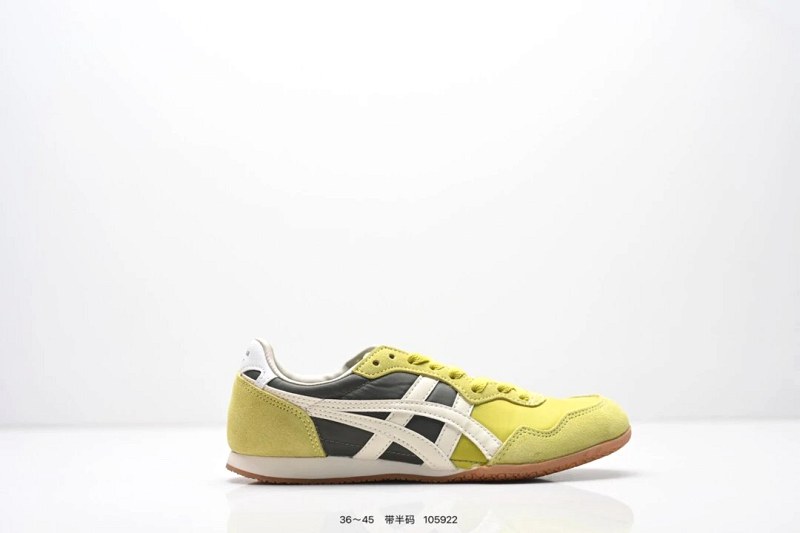
The Onitsuka Tiger Mexico 66 survives on proportion rather than technology: a low, narrow upper, a toe that turns up slightly, and a sole thin enough that you can feel the paving through it. This yellow pair, listed at $34.48 against a $40.95 original, claims exactly that shape. We ordered a pair through our agent, logged it into the Rotterdam studio, and spent just over 20 hours in it — indoors on the studio floor, outdoors on Schiekade paving and a stretch of brick — before scoring.
What arrived against what the page promises
Our pair matched the photography closely. Yellow base, black side stripes, white trim along the eyestay and heel, a leather-look toe bumper, white rubber outsole. Laid sole to sole, the pair was symmetrical; the stripes sat at the same height on both shoes and the stitching along them was even. We found loose thread ends at the collar lining of the left shoe, nothing a flame or a pair of scissors would not settle.
The real snag is in the listing text. The description filed under this SKU talks about a breathable leather-and-synthetic upper, a leather lining and a SOLYTE / EVA midsole — that is Serrano language, not Mexico 66 language. The article code quoted, 1183B400-407, is the Mexico 66 reference, and the pair we received reads as a Mexico 66 in profile. We still cannot tell you which description a given order will follow, so treat the material claims as unconfirmed and confirm both the model name and the article code on the order page before you pay.
Bench numbers
Every reading below is ours, taken on arrival with digital calipers, a steel tape and a calibrated scale, on an EU 42 sample. Listing figures are shown where the page gives any.
| Measurement | Our reading | Listing figure |
|---|---|---|
| Weight, one shoe (EU 42) | 251 g | Not listed |
| Heel stack, midsole plus outsole | 21.5 mm | “Thin sole” |
| Forefoot stack | 12.0 mm | “Thin sole” |
| Offset | Approx. 9.5 mm | Not listed |
| Insole length (EU 42) | 27.3 cm | Not listed |
| Outsole width at the widest forefoot point | 10.4 cm | Not listed |
| Insole | Removable, 4.1 mm foam | Not listed |
| Size run | 36–45 including half sizes | 36–45 including half sizes |
Two things follow from those numbers. At 251 g the shoe is light enough that you stop noticing it by mid-morning, and at 21.5 mm the heel is low enough that the heel-to-toe feel is flat and direct rather than cushioned. If you are used to a 30 mm-plus daily trainer, the first hour will feel like walking in a plimsoll.
Twenty hours on foot
The upper needed no break-in. Our reviewer wore the pair with thin cotton socks for the first four hours and barefoot for a short indoor stretch; the collar lining, which is the usual hotspot on low retro runners, stayed quiet. There is no arch support worth the name in the stock insole and the footbed is flat, so anyone who pronates heavily or spends the day on concrete should plan on a third-party insole, which the removable 4.1 mm foam liner makes easy.
On fit, the one independent report we hold is a Zappos buyer who found the Mexico 66 roomy and went a half size down for a “really nice” fit. Our EU 42 measured 27.3 cm of insole and wore close to a standard 42 with a thin sock, so we would call the pair true to size with a generous toe box rather than outright large. Because that is one report against one sample, order a size you can exchange if you sit between sizes.
Grip and the thin sole
Dry pavement is fine. Wet is not. The listing itself relays buyer feedback on this point, and our own test on damp tiles and a wet steel threshold produced the same result — short, skittery slides at the heel on the first step off a kerb. Translate that into a rule: this is a dry-weather shoe, and the rubber compound is thin enough that heavy urban mileage will wear the outsole edges before the upper shows anything.
Translated from the listing: “Rubber outsole, though buyers have reported it is not very slip-resistant — wear with caution on rainy days.”
Against two others in the price band
We compared the pair with a $29 canvas low-top and a $39 synthetic runner, both bought in the same haul. The canvas shoe was 60 g heavier per shoe and had a flatter, harder footbed; the synthetic runner was softer underfoot but visibly bulkier and lost the slim profile that makes this colourway work. The yellow Mexico 66 was the lightest and the best-proportioned of the three, and the only one whose upper held its shape through a full day without creasing across the toe box.
Care, colour and the open questions
The yellow upper wiped clean of road dust with a damp microfibre cloth and kept its tone; we would not machine-wash it. Store the pair away from direct sun, because yellow synthetic panels are the first place cheap pairs go chalky.
What we cannot settle is durability. One buyer who purchased a Mexico 66 from the official Onitsuka Tiger store in Harajuku reported serious quality problems after roughly two to three weeks of wear, and that is the only construction report in the record — an official-retail complaint, not a claim about this listing. Our pair showed no separation at the toe bumper or the stripe edge in 20 hours, which is not long enough to argue with that report either way. Treat construction as the open question here, not the resolved one.
How we tested
Tobias Lang wore the pair for 20+ hours across studio floor and Rotterdam street use. Calipers logged a 21.5 mm heel and 12.0 mm forefoot stack, a steel tape a 27.3 cm insole, and a calibrated scale 251 g for one EU 42 shoe. Two sub-$40 low-tops were compared alongside.
Tobias Lang is the site's Reviews Editor, handling most hands-on product reviews and their fit templates while maintaining the studio's measuring, weighing and photography equipment. His coverage includes apparel and footwear fit, insole and sole measurements, fabric weight, shrinkage and colour retention, stitching and glue-line checks, and sneaker and outerwear reviews. Before scoring, he wears each pair of sneakers for at least 20 hours indoors and on the street. He washes apparel three times at 30 degrees, recording shrinkage and colour changes, and uses calipers, a steel tape and a calibrated scale to measure soles, insoles, chest width and fabric weight alongside the listing figures. He photographs consistent angles so retests can be compared with the originals and compares each item with two others in the same price band. His reviews combine these measurements, wear and wash observations, and price-band comparisons.
What did your measurements actually show?
One EU 42 shoe weighed 251 g, with a 21.5 mm heel stack, 12.0 mm at the forefoot and a 27.3 cm removable insole. Widest outsole point measured 10.4 cm. The listing itself publishes no figures for these, so comparisons rest on our own bench.
Is $34.48 a fair price for this pair?
For a 251 g leather-and-synthetic retro runner with clean panel alignment, yes — it undercuts the $40.95 original and beat two sub-$40 comparators in our haul on weight and shape retention. The unresolved model description is the reason it is not a bargain verdict.
How does the yellow upper clean up?
Road dust and light scuffs came off with a damp microfibre cloth and the colour retained its tone. We would not machine-wash it, and yellow synthetic panels go chalky in direct sun, so store the pair away from a window.
Sources and notes
- Catalog product page
Product listing verified on 2026-11-01.