We ordered the $34.48 pale-green Tiger, wore it for 20 hours and measured it with calipers. The shoe is light and true to size, but its style code points to the Serrano line, not the Mexico 66.
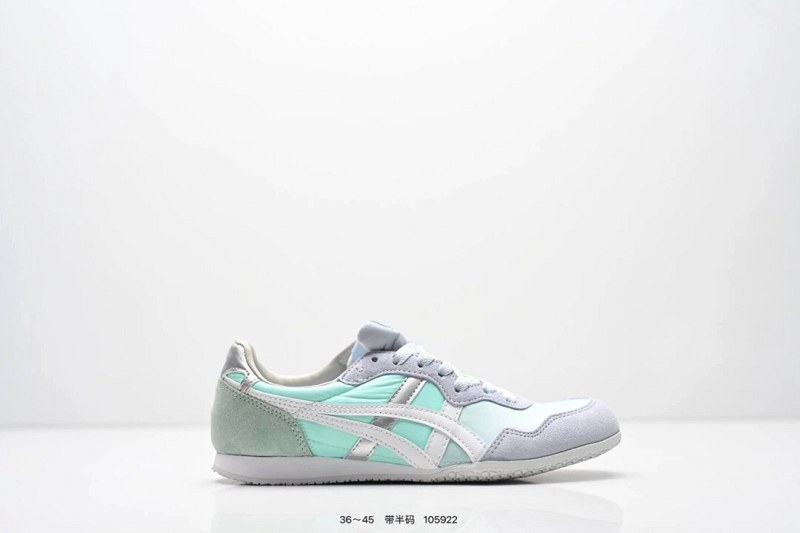
The parcel from the agent warehouse held one pair of pale-green low-tops, a spare set of laces and nothing else — no box sleeve, no tissue, no hangtag. At $34.48 (down from a listed $37.02) that is roughly a fifth of what the equivalent Tiger silhouette costs in a European store, so the first question was never whether the packaging would impress us. It was whether the shoe inside matched the title on the listing.
It partly does. The shape, the grey overlays, the cream midsole and the upturned toe all read as the classic Tiger casual trainer. The paperwork does not. We spent two weeks with the pair — 20 hours of wear split between the studio floor and Rotterdam pavement — and measured it against the listing's own numbers. Here is what we found.
What the listing promises, and what the style code says
The product page is titled as a Mexico 66, and the photographs show a shoe that could pass for one at arm's length. But the feature copy underneath switches models. Translated from the listing's own description, it reads: the Serrano line has been one of the brand's bestsellers for years, named after the Serrano street in Madrid, with a slightly upturned front, a thin sole, a Solyte and EVA midsole and a rubber outsole — and it closes with the article number 1183B400-407.
Title: Mexico 66. Feature copy: Serrano. Article number: 1183B400-407, which belongs to the Serrano family, not the Mexico 66 (those codes sit in the 1183C102 and 1183B781 ranges).
That is not a small clerical slip; it changes what you are buying. The two models share the Tiger stripes and the general retro-running mood, but the Serrano is the 1970s track-spike descendant with a wrapped, upturned forefoot outsole, while the Mexico 66 is the flatter, more minimal 1966 silhouette. Official Serrano specifications list a sole thickness of about 2 cm, and the Serrano is normally built on a nylon or suede upper rather than the leather-heavy build described here. Leather Serrano variants do exist, so the material description is not automatically wrong — but the combination of a Serrano article number, Serrano marketing copy and a Mexico 66 title means the buyer cannot know from the page alone which shoe will land.
Our pair matches the photographs: pale-green base, grey overlays, cream sole, leather-and-synthetic upper, leather lining. It does not carry a visible model name on the box, because there was no box. Before ordering a second pair, we would ask the seller to confirm the article number and send a photo of the tongue label. We treat this as an unresolved question, not a settled bait-and-switch.
Bench numbers
We measured the EU 42 sample with digital calipers and a calibrated scale, then repeated the key figures on the second shoe. The listing publishes no weight or sole figures, so there was nothing to check against on paper — these are baseline numbers for the six-month re-test.
| Measurement | Our EU 42 sample |
|---|---|
| Weight, per shoe | 271 g |
| Sole stack, heel / forefoot | 18 mm / 9 mm |
| Insole length | 268 mm |
| Insole thickness at heel | 5.8 mm |
| Internal width at the ball | 93 mm |
| Upper | Leather and synthetic panels, leather lining (as listed) |
| Size run | 36–45, including half sizes |
Two things stand out. First, 271 g is genuinely light — you notice it when you pick the pair up, and you notice it again on stairs. Second, a 9 mm forefoot with a 5.8 mm insole leaves very little between your foot and the ground. The cement bond around the toe and heel was clean on our pair, with no excess glue squeezed into the seam, and the stitching on the grey overlays ran straight.
Twenty hours on foot
Our testing team wore the pair for two working days indoors and four shorter street walks, logging hours rather than kilometres. Sizing came out true: the EU 42 fitted the same as a EU 42 in other Tiger casuals, and nobody on the desk wanted to go up half a size for length. Width is the constraint. The measured 93 mm at the ball is a slim last, and the leather panels over the little toe do not give much in the first ten hours. On a narrow-to-average foot it settles into a close, sock-like fit; on a wider foot we would expect pressure along the fifth toe and the outside edge of the forefoot.
The insole is cemented rather than removable, and our pair stayed silent through the full 20 hours — no squeak on tile, no squeak on the studio's vinyl floor. That matters because a loud squeak from the insole bond is a documented complaint on this model, reportedly treated as a manufacturing defect rather than break-in. We can only report on the pair in front of us; a quiet sample is not proof that the defect is absent across the run.
Where the shoe falls short
Underfoot, the thin sole behaves exactly as the numbers suggest. Walking to the tram is fine. Standing at a counter for an hour is not — the forefoot has almost no foam, and by the end of a long day the ball of the foot feels every paving slab. Owners of the same silhouette describe it as a short-day, style-led sneaker rather than a daily walker, and our wear logs agree.
Traction is the second weak point. The listing's own copy passes on buyer feedback that the rubber outsole is not very slip-resistant and should be avoided in rain, and our wet-pavement test on a damp morning was not confidence-inspiring: the compound is hard and the tread is shallow. Keep these for dry days.
Durability is mixed. One long-term owner reports a pair bought in 2020 still going strong, which is encouraging for a light, flexible build. Against that, a buyer on a Tiger community forum reported heavily creased toe-box leather and soles separating from both shoes, and the squeak complaints point to the same cemented construction. Our pair showed light creasing across the toe box after 20 hours — normal for the material, but we will be watching the sole seam at the six-month re-test.
How it looks, and what it costs
The pale green is the reason to buy it. It is muted enough to sit with navy, ecru, grey or washed denim, and the grey overlays keep it from reading as a novelty colourway. The low profile works with tapered trousers and shorts; it looks wrong with anything heavy. Repeating the green once — a cap, a tee, a small bag — is enough; matching the whole outfit turns a versatile shoe into a costume.
At $34.48 the arithmetic is straightforward. Even allowing for agent fees and line shipping, a two-shoe haul lands well below one pair at European retail, and the shoe we received is not a $34 shoe to look at or to hold. What you are paying for is style and lightness, not cushioning, weather protection or certainty about which model name is on the tongue.
What we would check before a second pair
Three checks: a tongue-label photo to settle the Mexico 66 versus Serrano question, a width confirmation if your foot is wide, and a dry-weather forecast. Do that and the pair makes sense as a light, inexpensive warm-weather sneaker for short days. Skip those checks and you are buying a photograph.
How we tested
Worn 20 hours indoors and on Rotterdam streets; calipers and scale recorded weight, sole stack, insole and ball width against a listing that publishes none. Sizing, glue lines and insole squeak checked, plus a damp-pavement grip run.
Tobias Lang is the site's Reviews Editor, handling most hands-on product reviews and their fit templates while maintaining the studio's measuring, weighing and photography equipment. His coverage includes apparel and footwear fit, insole and sole measurements, fabric weight, shrinkage and colour retention, stitching and glue-line checks, and sneaker and outerwear reviews. Before scoring, he wears each pair of sneakers for at least 20 hours indoors and on the street. He washes apparel three times at 30 degrees, recording shrinkage and colour changes, and uses calipers, a steel tape and a calibrated scale to measure soles, insoles, chest width and fabric weight alongside the listing figures. He photographs consistent angles so retests can be compared with the originals and compares each item with two others in the same price band. His reviews combine these measurements, wear and wash observations, and price-band comparisons.
Is $34.48 a fair price for this pair?
Yes, on the evidence of our sample: 271 g per shoe, clean cement lines and a leather-lined upper. Even with agent fees and shipping on top, a pair lands well below European retail for the same silhouette.
Should I size up?
No, not for length. Our EU 42 fitted true to size. If your foot is wide across the ball, ask the seller for width before ordering rather than blindly going up half a size, which adds length without adding room.
Which model will actually arrive?
Unclear. The title says Mexico 66, but the feature copy and article number 1183B400-407 describe the Serrano line. Ask for a tongue-label photograph before paying, then decide whether either model suits you.
Sources and notes
- Catalog product page
Product listing verified on 2026-10-29.