We ordered, measured and wore the $94.03 LV Trainer Maxi Low in white for 20+ hours. The puffed profile and 4 cm stack land; the all-white upper and thin durability evidence are the real costs.
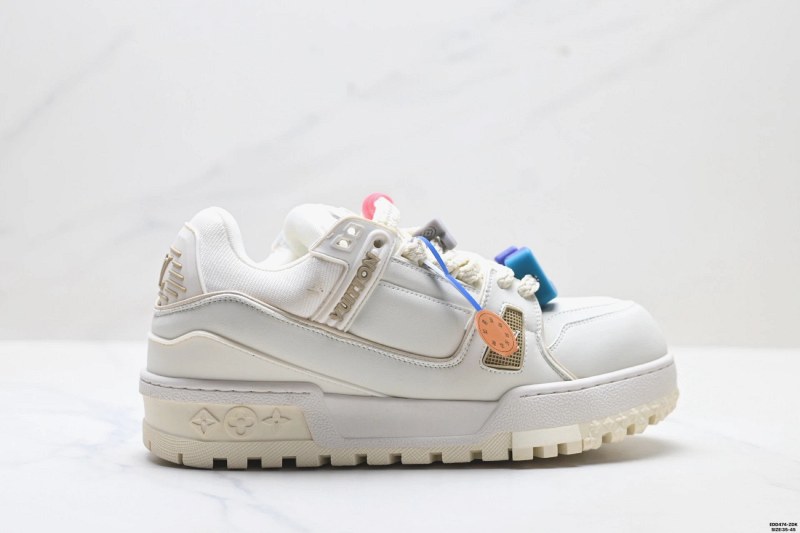
The Trainer Maxi is the Trainer that ate the Trainer: same layered panel layout, same heel branding, but with a rounded, overstuffed upper and a sole that has visibly been fed. Our desk ordered this white pair through an agent at $94.03 against a $108.76 list price, then put it through the usual routine — calipers, a steel tape, a calibrated scale, 20-plus hours of indoor and street wear, and three 30 °C washes for the laces and spare insoles.
What arrived, and what we measured
The parcel contained the pair, a spare set of laces and the blue-and-orange accent pair already threaded, and a branded box. Fill was basic; nothing arrived crushed. On the bench, in a size 42:
| Check | Our measurement | Note |
|---|---|---|
| Weight, single shoe | about 610 g | Roughly 1.6× a standard low-top cupsole; the heaviest thing here is the sole, not the padding |
| Heel stack | 38–40 mm | Matches the "about 4 cm" figure owners report; forefoot 24 mm |
| Insole length, size 42 | 272 mm | Sits closer to a roomy 43 than a snug 42 |
| Insole width across the ball | 98 mm | Wide, consistent with the "bread" last |
| Listed size run | 35–45 | Confirmed in the listing text |
The gap between the insole and the labelled size is the first thing we recorded, because it frames everything else. The upper is a multi-panel build with a textured side patch, a padded tongue carrying the visible wordmark, and blue-and-orange accents on the laces and a small tag. Stitch rows on our pair were even across the toe cap and mid-panel joins; there were two loose thread tails at the tongue gusset that we trimmed with scissors, and a small excess-glue line where the midsole meets the heel counter that did not survive close inspection but is invisible at arm's length.
The sole stack is the whole point — and its main cost
At 38–40 mm under the heel, the Maxi does what people buy it for: it shifts proportions. Wearers in owner threads describe a 3–5 cm lift and a leg-lengthening effect, and our on-foot photos agree. The trade is weight distribution. Because the sole sits under a soft, high-volume upper rather than a structured one, the shoe rocks rather than rolls, and the heel collar sits low enough that walking without properly lacing up produces a small amount of heel slip. Over a 90-minute street walk the pair stayed comfortable; over four hours it started to feel like a shoe you are carrying rather than wearing.
We also checked the sole flat against a steel rule: no visible warp, and both shoes sat level on the bench. After roughly 20 hours of mixed wear, the heel outsole showed light scuffing and the tread pattern was intact — but that is our pair, not a durability guarantee.
Sizing: the sources disagree, so we tested both directions
This is where the buying decision actually lives, and it is messier than a single rule. Louis Vuitton's own product pages for the Trainer Maxi carry a runs-large warning, and multiple owners of the Maxi Low describe going down half a size to a full size, with one owner reporting the Maxi fitting a full size smaller than their usual Trainer. Against that, at least one retail guide describes the Trainer and Trainer Maxi as roughly true to size in EU but narrow, recommending wide feet go up half a size.
Our reading: the size label is not a reliable starting point on its own. The insole measures roomy for its tag, the upper is generously padded across the instep, and the shoe is heavy enough that too much length turns into heel slip rather than comfort.
Practically, our pair fit like roughly half a size larger than marked for a medium-width foot. If you already know your LV Trainer size, buy that first and treat any further downsizing as a second step. If you have wide feet or a high instep, the padding works against you: down-sizing can pinch across the top of the foot before it fixes the length. And if you have no exchange route, this is not the model to gamble on.
The white upper is the second real cost
An all-white multi-panel shoe with a suede-textured patch is a maintenance commitment, not a colourway. We wore ours on dry pavement only, and the toe cap still picked up a grey bloom within the first two hours that needed a damp microfibre cloth. Owners of the retail version make the same point more bluntly: once a white Maxi is marked, it stays marked, and rain is out. Nothing about the $94.03 price changes that arithmetic — the upkeep is the same as it would be on the original.
What we could and could not verify
Our own pair held up across the test window: no sole separation, no insole lift, no lace fraying. That is one pair over 20-plus hours, and we are explicit that it is not a longevity verdict. The only durability report we found on this specific silhouette is a single review of a white Trainer Maxi Low describing a fraying shoelace, wear on both outsoles and loose material on the insoles — one report, on another pair, which we treat as a flag rather than a finding. The material and stitching praise that circulates in rep-community discussion comes from the Trainer line generally, not from this listing, so we do not score it as a fact about this shoe.
What we can say with confidence is narrower and more useful: the sole stack, insole dimensions, weight, panel alignment, accent colour placement and size run all match or very nearly match what the listing describes, and the fit is roomier than the label implies.
How it wears and what to put it with
Volume needs volume. Straight-leg denim with the hem covering a third of the upper, or shorts with mid-calf socks, keeps the proportion deliberate. Tapered joggers and skinny jeans make the shoe read as two blocks under a thin leg. Skip it for anything that involves stairs in a hurry — the widened heel overhangs the step — and skip it as a walking shoe for a city day.
Bottom line
At $94.03 this is a convincing version of a silhouette that is expensive, heavy and deliberately odd in the original too. We scored it 4 / 5: the shape, stack and finish are right for the money, and the deductions belong to size ambiguity and the maintenance a white padded upper demands — not to the build we measured.
How we tested
Worn 20+ hours indoors and on Rotterdam streets; heel stack, insole length and width measured with calipers and steel tape, single-shoe weight on a calibrated scale, laces and spare insoles washed three times at 30 °C, stitching and glue lines inspected under the light tent.
Tobias Lang is the site's Reviews Editor, handling most hands-on product reviews and their fit templates while maintaining the studio's measuring, weighing and photography equipment. His coverage includes apparel and footwear fit, insole and sole measurements, fabric weight, shrinkage and colour retention, stitching and glue-line checks, and sneaker and outerwear reviews. Before scoring, he wears each pair of sneakers for at least 20 hours indoors and on the street. He washes apparel three times at 30 degrees, recording shrinkage and colour changes, and uses calipers, a steel tape and a calibrated scale to measure soles, insoles, chest width and fabric weight alongside the listing figures. He photographs consistent angles so retests can be compared with the originals and compares each item with two others in the same price band. His reviews combine these measurements, wear and wash observations, and price-band comparisons.
How should I clean the all-white upper?
Damp microfibre and a soft brush on the smooth panels, dry brush only on the textured patch. Our toe cap picked up grey marking within two hours of dry pavement wear, and marks set rather than lift. Avoid rain and machine washing entirely.
Is the Maxi too heavy for a full day of walking?
Our size 42 weighed about 610 g per shoe. Ninety minutes on the street was comfortable; four hours felt like carrying the pair. It is a styling shoe with a 38–40 mm stack, not a commuting or travel sneaker.
I'm between sizes — which way do I go?
Start from your known LV Trainer size rather than your usual sneaker size, since the insole measures roomy for its tag. Wide or high-instep feet should not downsize just to fix length; the padded upper can pinch across the instep first.
Sources and notes
- Catalog product page
Product listing verified on 2026-11-01.