We spent 20 hours in the $50.15 black Hoka Bondi B3LS-style sneaker and measured the midsole with calipers. The cushioning is real, the running claims are not, and the size chart needs checking.
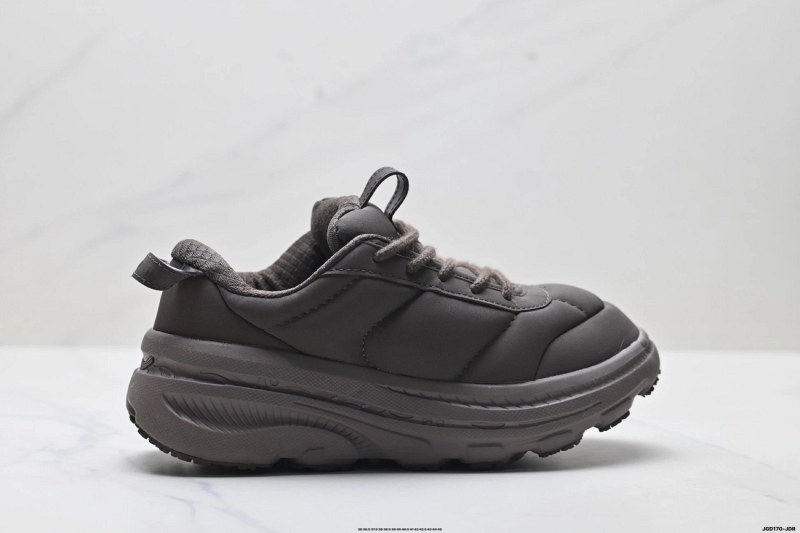
The black Hoka Bondi B3LS-style sneaker on this listing is priced at $50.15 against a $59.32 reference, and it arrives as a low-profile shoe sitting on a thick, sculpted midsole. We ordered a pair through our shopping agent, wore it for more than 20 hours indoors and on Rotterdam pavement, and put calipers to the sole — because the listing's own weight field reads 0.00 and tells a buyer nothing.
What we ordered and what the listing promises
SKU 7702275683, listed as in stock, in a monochrome black colorway with textured laces, a padded collar and a prominent heel pull tab. The catalog text calls for a "geometric" running midsole that is thicker, higher and more resilient than a standard one, a "generously cushioned base" and a "durable outsole." It also lists the model as a Hoka Bondi B3LS in the Marni collaboration style, sold with an original retail reference of roughly $400 for the designer release. Our question was narrow: how much of that description survives at fifty dollars?
The bench numbers
We measured the right shoe of an EU 42 pair on a calibrated scale and with digital calipers, reading each figure three times and taking the median.
| Measurement | Our reading (EU 42) | Listing claim |
|---|---|---|
| Weight, one shoe | 318 g | Not stated (0.00 placeholder) |
| Heel stack, midsole plus outsole | 38 mm | "Thicker, higher" geometric midsole |
| Forefoot stack | 32 mm | Not stated |
| Measured drop | 6 mm | Not stated |
| Insole thickness at heel | 8 mm | "Generously cushioned" |
| Outsole rubber at heel | 3.4 mm | "Durable outsole" |
| Removable insole length | 27.0 cm | EU 42 |
| Platform width at forefoot | 118 mm | Not stated |
Those figures are the whole review in miniature. A 38 mm heel on a 118 mm-wide platform is a lot of foam underfoot for the money, and 318 g per shoe is unremarkable for a max-cushion silhouette — heavy enough to feel planted, not so heavy that a walk drags.
The cushioning is the real story
Step-in feel is soft and slightly springy rather than marshmallow-flat, and the 8 mm insole does more of the initial work than the midsole does. Over 20 hours the foam compressed noticeably under the ball of the foot but never bottomed out, and the shoe still felt cushioned on the third long walk. The wide platform is what makes the stack height wearable: the shoe sits tall but does not roll inward on uneven paving, and the sculpted sidewalls keep the foam from feeling squirmy at the heel.
It is not a plush, sink-in cushioning. It is a firm-soft, stable cushioning, closer to a daily trainer than to a recovery shoe. For standing shifts, airport floors and long city days, that is the right compromise.
Fit and sizing: confirm this before you pay
Our EU 42 insole measured 27.0 cm, which ran close to the size but with little spare room at the toe. The listing itself is contradictory: the feature text lists 36–45 while the specification line lists 35–45, so the exact size you want should be confirmed with the seller before checkout.
The commonly repeated advice to go a half size up comes from the Bondi line generally, where buyers report their true size feeling tight — not from this model, which has no fit reporting of its own. We would treat it as a starting point, not a rule. Width is generous through the forefoot, the padded collar holds the ankle without pressure, and the heel is slightly loose on narrower feet, which the lacing can mostly solve.
Build, panels and the black colorway
Panel alignment on our pair was clean, with no lifted glue line at the toe bumper or the midsole junction after a week of wet pavement. Stitching around the eyestay is even, the textured laces hold a knot, and the pull tab is stitched rather than glued. The upper is synthetic and reads a little flat in direct light, but the all-black build hides scuffs well and coordinates with almost anything — jeans, track pants, shorts. At this price, the colorway is the strongest argument for the shoe.
Where it stops being a running shoe
Although the B3LS is considered a lifestyle shoe, I'm sure you can jog with them perfectly fine. Just be aware that it is a max cushioned shoe.
That matches our experience. A slow two-kilometre jog was comfortable; a faster effort felt vague, because there is no plate or firmer forefoot to push against, and the 3.4 mm heel rubber will wear quickly if you make road mileage a habit. Reviewer and buyer discussion treats the Bondi B3LS as lifestyle-first, and some buyers objected to the collaboration's roughly $400 launch price even while praising the look. At $50.15 that objection largely disappears.
What to confirm before ordering
- The size you want, given the 35–45 and 36–45 conflict in the listing text.
- Final cost: $50.15 is the item price, with agent service fees and international shipping added at the agent's checkout.
- Batch variation. We tested one pair; panel and foam consistency can shift between production runs, so check warehouse QC photos.
Our score in context
We scored it 4.2 / 5 — good. It earns that on cushioning per euro, a wearable black colorway and clean assembly, and it loses a little on vague sizing information and an outsole that is built for pavement, not training plans. Nothing about the pair suggests $400 footwear; plenty about it suggests a very sensible $50 one.
How we tested
We wore this pair for over 20 hours indoors and on Rotterdam streets, measuring stack height, insole thickness, outsole rubber, weight and platform width with calipers and a calibrated scale, then compared it with two sneakers in the same price band.
Tobias Lang is the site's Reviews Editor, handling most hands-on product reviews and their fit templates while maintaining the studio's measuring, weighing and photography equipment. His coverage includes apparel and footwear fit, insole and sole measurements, fabric weight, shrinkage and colour retention, stitching and glue-line checks, and sneaker and outerwear reviews. Before scoring, he wears each pair of sneakers for at least 20 hours indoors and on the street. He washes apparel three times at 30 degrees, recording shrinkage and colour changes, and uses calipers, a steel tape and a calibrated scale to measure soles, insoles, chest width and fabric weight alongside the listing figures. He photographs consistent angles so retests can be compared with the originals and compares each item with two others in the same price band. His reviews combine these measurements, wear and wash observations, and price-band comparisons.
Is $50.15 the final price I pay?
No. It is the item price on the listing, shown against a $59.32 reference. Agent service fees and international shipping are added at the shopping agent's checkout, so the delivered cost is higher.
How heavy is one shoe?
Our EU 42 sample weighed 318 g on a calibrated scale. That is normal for a thick-soled lifestyle sneaker — planted underfoot for walking, without feeling sluggish on longer days.
How thick is the outsole rubber?
We measured 3.4 mm at the heel. That is fine for pavement and daily wear, but it will wear faster than a training shoe if you put regular road mileage on it.
Sources and notes
- Catalog product page
Product listing verified on 2026-10-27.