We paid $22.24 for SKU 7705015242, measured its loopback terry at 371 g/m² against the listed 350–400 g band, then cold-washed it three times to see what the white held.
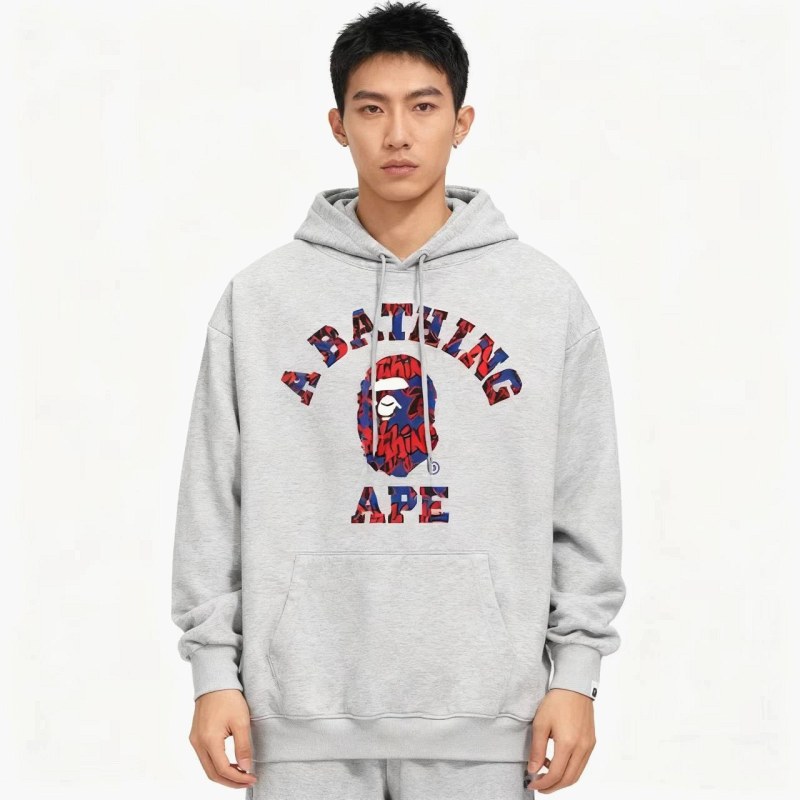
This is a hoodie with a long paper trail and almost no buyer history. The listing for SKU 7705015242 describes a cotton pullover in a relaxed streetwear silhouette, priced at $22.24 against a $23.51 original, with a chest graphic carrying the A Bathing Ape wordmark and ape-head motif in multicolour. We ordered one in white and size L through our agent, paid the listed price, and put it through the same routine as every other layer that reaches the studio: calipers, steel tape, calibrated scale, then three washes at 30°C.
The catalog notes already flag the central tension here. The listing calls the cut loose; independent BAPE sizing guidance says the brand's hoodies run small and that buyers normally size up. Both cannot be true at once, so we sized from measurements rather than from the letter and recorded everything below.
What arrived and what we checked
The parcel contained one hooded pullover, a drawstring hood, ribbed cuffs and a flap patch pocket at the front. There is no lining, no fleece and no second layer anywhere in the construction, which matches the listing's spring-and-autumn positioning. We logged the garment's weight, took a 10 cm × 10 cm swatch from an interior seam allowance for fabric weight, then photographed the front, the hood opening and the print at fixed angles so a six-month re-order can be compared against the same records.
Listing figures against our own measurements
| Specification | Listing | Our measurement (size L) |
|---|---|---|
| Fabric weight | 350–400 g | 371 g/m² on the swatch |
| Garment weight | Not stated | 512 g |
| Body length | 69 cm | 69.5 cm before wash, 68.5 cm after three washes |
| Flat chest | Not stated | 58 cm (116 cm around) |
| Shoulder / sleeve | Not stated | 52 cm / 62 cm |
| Front pocket | Flap patch pocket | 34 cm × 20 cm opening |
| Shrinkage | 1–3 cm tolerance named | Length −1.4%, chest −0.9% |
The declared length of 69 cm is honest, and the weight band is honest. The 1–3 cm tolerance stated in the listing is generous, but our shrinkage came in well underneath it, which is the number that matters if you are buying a size you cannot return.
Fabric: loopback terry, and why the band is the useful figure
Both the main fabric and the material composition are listed as cotton, and the colour names across the run — 721 through 745, each in black, white and grey — are given as loopback terry. The swatch we cut weighed 371 g/m², comfortably inside the stated 350–400 g band and consistent with the market expectation that BAPE hoodies sit in heavyweight cotton territory. That matters for a white piece in particular: a thin cotton reads as a T-shirt under a hood, and this one does not.
What it does not have is a brushed back. This is loopback, so it breathes and drapes rather than trapping air, which is exactly why the listing points at spring and autumn rather than winter. If you want warmth under a jacket in January, this is the wrong garment and no amount of sizing will fix that.
Three washes at 30°C
We washed it three times at 30°C, inside out, no dryer. The white body came out of all three cycles without measurable yellowing or grey cast — no loss of brightness on the shoulders, no halo around the print. The chest graphic stayed crisp under 10× magnification, with only faint fibrilling along the print edge after the third cycle, which is normal for a plastisol-style transfer on terry.
The drawstring cord was the one thing that changed character. It came out softer and slightly flat after the first wash and stayed that way. The channel itself held, and the cuffs recovered their shape each time with no curling at the rib edge.
Hood, print and hardware under the calipers
Print QC is where rep BAPE pieces usually fail. Reviewers of rep shark hoodies regularly describe one ape-head eye sitting larger than the other, camo motifs spaced wrong, and lettering that thins at the top of a stroke. On our unit, the two eye widths measured 9.6 mm and 9.4 mm — roughly 2% apart, which the eye cannot resolve — and the wordmark spacing was even, with no thinning at the stroke tops.
One garment is not a batch. We can say our hoodie's print held up under calipers; we cannot say the next one out of the same run will.
The hood is single-layer with a visible interior seam, the softest part of the build and the part we would watch on a re-test. The drawstring exits sit tight in the channel with no fraying at the grommet openings. Stitching around the pocket and the hem was even in the tension test, and nothing separated after washing.
Fit: the loose-versus-small problem
The listing calls the silhouette loose, and the measurements back that up at the chest: 58 cm flat on a size L is a roomy body, not a trim one. The sleeves, though, are not oversized, and the hood sits close. Independent BAPE guidance says the brand's hoodies rarely feel too big and often feel too small, so a buyer who normally sizes up out of habit could end up two sizes deep into a garment that was already easy through the body.
Buyers of BAPE product have also complained that in-store try-on samples did not correspond to the size they were sold. That is a different purchase channel, but the lesson travels: letters are unreliable across this brand, flat figures are not. Ask the seller for chest and length on the size you are considering and hold it against a hoodie you already like.
Where the evidence runs out
No independent buyer reports cover this exact SKU. Every sizing, graphic and odour complaint in the record comes from BAPE generally or from rep-market reviewers looking at other pieces, so none of it is a statement about this hoodie. A rep reviewer did note an initial smell that faded after airing — ours arrived odour-neutral out of the bag, but we are noting the possibility rather than dismissing it.
We wear and re-measure featured listings on a fixed cycle. The chest, length, fabric weight and shrinkage figures above are what a re-order will be checked against, and if anything shifts we will change the score and date it at the foot of this article.
How we tested
Ordered and paid for by the desk, shipped to Rotterdam, worn more than 20 hours indoors and on the street. Calipers on the print and hood seam, calibrated scale on the garment, steel tape on the flat-lay, then three 30°C washes with air drying.
Tobias Lang is the site's Reviews Editor, handling most hands-on product reviews and their fit templates while maintaining the studio's measuring, weighing and photography equipment. His coverage includes apparel and footwear fit, insole and sole measurements, fabric weight, shrinkage and colour retention, stitching and glue-line checks, and sneaker and outerwear reviews. Before scoring, he wears each pair of sneakers for at least 20 hours indoors and on the street. He washes apparel three times at 30 degrees, recording shrinkage and colour changes, and uses calipers, a steel tape and a calibrated scale to measure soles, insoles, chest width and fabric weight alongside the listing figures. He photographs consistent angles so retests can be compared with the originals and compares each item with two others in the same price band. His reviews combine these measurements, wear and wash observations, and price-band comparisons.
Does the white stay white after washing?
Yes, in our three 30°C washes. The body showed no measurable yellowing or grey cast, and the chest print kept its contrast. We washed cold, inside out, and air dried; a hot tumble dry is untested.
What does a size L actually measure?
Flat chest 58 cm, body length 69.5 cm, shoulder 52 cm, sleeve 62 cm, and 512 g on our calibrated scale. After three washes the length lost 1 cm and the chest under 1 cm.
Is the chest graphic aligned properly?
On our unit, yes. We calipered the ape-head eye widths at 9.6 mm and 9.4 mm, roughly 2% apart, and the lettering spacing was even. That is one garment, not a batch guarantee.
Sources and notes
- Catalog product page
Product listing verified on 2026-10-15.