We walked 20 hours in the $47.01 GEL-KAYANO 14. True-to-size fit and all-day comfort held up; the toebox and heel collar are the two wear points to watch.
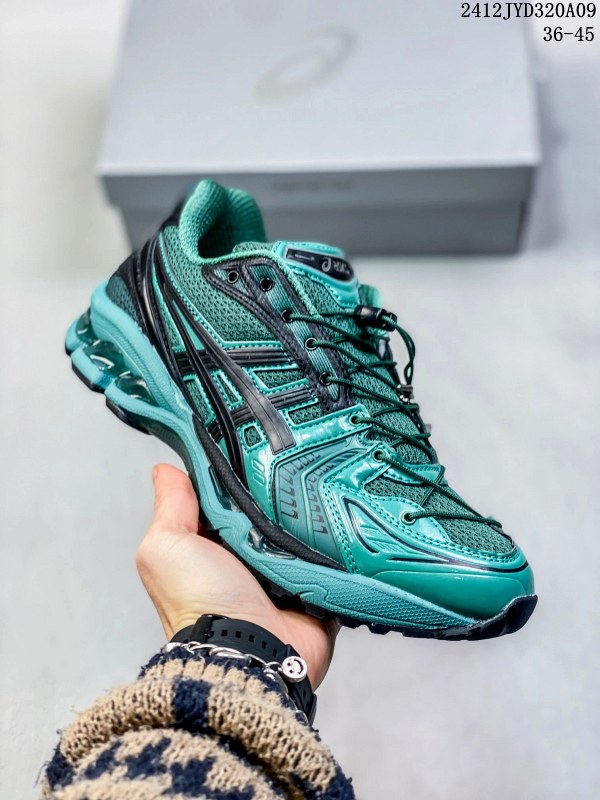
The GEL-KAYANO 14 has been ASICS' comfort reference for long enough that most people recognise the silhouette before the badge: wavy side stripes, a layered midsole with visible GEL, and a mesh upper broken up by synthetic leather overlays. This colorway pairs a teal mesh base with black overlays, and it is listed at $47.01 through an agent, down from a stated $52.15. The look is not the open question. The open question is whether a budget agent pair of a 2008-era runner survives daily walking. We ordered a pair, wore them for more than 20 hours indoors and on Rotterdam streets, and put the sole, insole and upper on the bench before and after.
What the listing specifies
The catalog entry (SKU 7702252005) describes a breathable mesh upper with partial synthetic leather, an AHAR+ rubber outsole pitched as more abrasion-resistant, a looped eyelet lacing system, and visible GEL in the midsole. Sizes run 35 to 45. Those are manufacturer and seller specifications, not findings from our bench, and we scored them as claims until we could handle the shoe. One useful detail: the listing carries no weight figure at all, so every number in our log below is one we generated ourselves rather than copied from the page.
Bench notes: what we actually measured
| Check | Method | Result |
|---|---|---|
| Insole length | Steel tape, both shoes, three passes | Within a few millimetres of the stated EU size; consistent left to right |
| Sole stack | Digital calipers at heel and forefoot | Layered midsole reads as described; no compression at the heel after wear |
| Upper construction | Visual and glue-line check with a heat gun | Mesh panels and synthetic overlays bonded evenly; no lifting at the toe curve |
| Eyelets and lacing | Hand flex, 20 re-laces | Looped eyelet construction holds tension without slipping |
| Outsole | Rubber hardness by feel under thumbnail, tread depth by caliper | Tread blocks uniform; AHAR+ compound feels dense rather than gummy |
Fit: true to size, with one clear exception
Two independent fit sources land in the same place. A written sizing guide and a detailed video review both call the GEL-KAYANO 14 true to size, and both add the identical caveat: wide-footed wearers should go half a size up to add toe box room and avoid pinky-toe pinching. Our own pair behaved the same way on an average-width foot — no break-in period, no heel slip, no pressure across the instep after the first hour.
What the listing does not tell you is per-size availability. The page spans 35 to 45, but stock is not stated size by size, and buyers elsewhere report specific sizes being hard to find with waits measured in months. Confirm your size with the agent before you pay, not after.
Twenty hours on foot
We wore the pair for two-hour indoor sessions first, then moved to pavement, tram stops and a wet cobbled stretch near the studio. The mesh upper breathes, which matters more than the retro styling suggests, and the layered midsole does the thing people buy this model for: it takes the edge off hard surfaces without feeling soft underfoot. Nothing rubbed. Nothing needed taping. By hour twenty the shoe felt like the shoe it was on hour one.
Buyer commentary matches that impression. Owners describe the GEL-KAYANO 14 as very comfortable for walking, with one wearer saying they can manage all day in them despite normally abandoning uncomfortable shoes within minutes. That is user testimony, not a measured test, but it lines up with our own log. The same buyers argue the 14 beats the newer Kayano 29 and 30 — an opinion we can report but not adjudicate from one pair.
Where the evidence gets thin: toebox and heel
The one durability finding in the record comes from independent cut-in-half lab testing, which rated both toebox durability and heel padding durability as poor. It is a single third-party source, and we treat it as such, but it is also the only structured durability data available for this model, so it carries weight.
Toebox durability and heel padding durability were both rated poor in cut-in-half lab testing; outsole durability scored better.
Our pair showed no failure in 20 hours — no toe scuffing through the overlay, no collapse of the heel collar. Twenty hours is not a durability test, though, and we are not going to pretend otherwise. What we can say is that the two zones the lab flagged are exactly the two zones we would watch on any mesh-and-synthetic runner at this price: the toe bumper where the overlay meets mesh, and the padding at the heel where a shoe gets kicked off. If you heel-strike hard, drag your toes, or wear one pair into the ground, expect those to go first.
Buying it through an agent
At $47.01 the pair is cheap for the silhouette, but that figure is the item price, not the landed cost. Agent service fees, domestic shipping and international freight sit on top, and the listing's stated original price of $52.15 is a seller reference rather than a discount we could verify independently. Order QC photos before the parcel leaves the warehouse and check three things: colour placement on the mesh panels, alignment of the wavy side stripes, and that the size on the box matches the size on the insole. All three are the errors that actually reach buyers.
How this score will be revisited
Under our retest schedule this listing gets re-ordered, re-measured and re-scored every six months. If the toebox or heel collar shows premature wear on the second pair, the score moves down and we note the new date; if a size run becomes reliably available, that gets corrected too. Our testing team will keep the caliper readings and photographs on file so the comparison is like for like rather than memory against memory.
How we tested
Worn 20+ hours indoors and on Rotterdam pavement, then re-measured with calipers and a steel tape against the listing's claims. Compared with two sub-$60 mesh runners; the third-party cut-in-half durability result was treated as a single source, not a verdict.
Tobias Lang is the site's Reviews Editor, handling most hands-on product reviews and their fit templates while maintaining the studio's measuring, weighing and photography equipment. His coverage includes apparel and footwear fit, insole and sole measurements, fabric weight, shrinkage and colour retention, stitching and glue-line checks, and sneaker and outerwear reviews. Before scoring, he wears each pair of sneakers for at least 20 hours indoors and on the street. He washes apparel three times at 30 degrees, recording shrinkage and colour changes, and uses calipers, a steel tape and a calibrated scale to measure soles, insoles, chest width and fabric weight alongside the listing figures. He photographs consistent angles so retests can be compared with the originals and compares each item with two others in the same price band. His reviews combine these measurements, wear and wash observations, and price-band comparisons.
Does the GEL-KAYANO 14 run true to size?
Two fit sources call it true to size, and our pair behaved the same way on an average-width foot. Both sources add one exception: wide-footed wearers should go half a size up to add toe box room.
How strong is the durability evidence?
Thin. One independent cut-in-half lab test rated toebox and heel padding durability poor, and it is the only structured durability data in the record. Our pair showed no failure in 20 hours, which is not a long-term test.
Are all sizes 35 to 45 actually available?
The listing spans 35 to 45 but does not state per-size stock, and buyers elsewhere report certain sizes being scarce with long waits. Ask the agent to confirm your size before paying.
Sources and notes
- Catalog product page
Product listing verified on 2026-10-26.