We ordered the $104.48 red Arc'teryx shell, measured it flat on the bench and washed it three times at 30 °C. The colour held; the "hard shell" name did not.
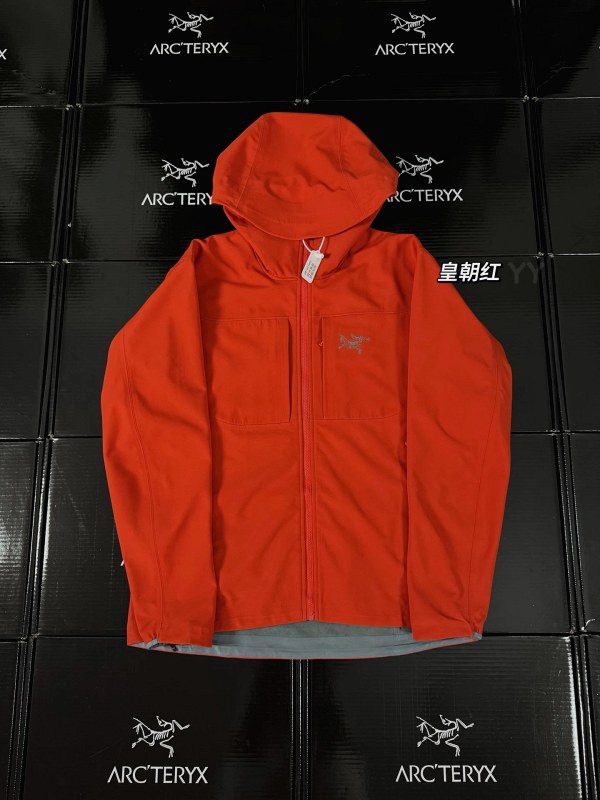
Two different jackets arrive in the same parcel. One is the one the listing names: an Arc'teryx "hard shell" in red, full-zip, hooded, two symmetrical chest pockets, logo on the left chest, $104.48 against a $119.79 original. The other is the jacket the photographs, the fleece lining and the Chinese specification sheet actually describe: a Gamma MX Hoody–style softshell, taped at the seams, finished with a DWR, and built for cool-weather commuting rather than a storm. We ordered a Medium in Imperial Red and spent three weeks working out which of the two we had been sent.
Our answer, before the detail: the second one. That is not a small distinction, because it changes what you should expect from the jacket in rain, how much mid-layer you can wear under it, and how you read a size chart that already argues with itself.
What arrived, and what our tape said
Everything was measured flat, seam to seam, on the bench, with the same steel tape and calipers we use for every outerwear item, then weighed on the calibrated scale before the tags came off. We recorded the listing's figures next to ours for comparison.
| Check | Listed | Our Medium |
|---|---|---|
| Weight | Not stated (0.00 in the catalog record) | 596 g |
| Chest, flat | 118 cm circumference | 116 cm circumference (58 cm flat) |
| Back length | 72 cm | 71.5 cm |
| Shoulder | 48.5 cm | 49 cm |
| Sleeve | 64 cm | 63.5 cm |
| Seams | "Fully taped" | Tape present at shoulders, armholes and main vertical seams |
Those are tight tolerances — inside a centimetre on every dimension we could check — so the pattern this listing is cut from matches the pattern it publishes. Where the sourcing sheet gets strange is the chest row across the run: 110, 114, 118, 112, 126, 130 cm. The fourth figure drops six centimetres before climbing again, and the same sheet lists the range as both XS–XXL and S–3XL. One of those numbers is a transcription error, and the jacket in our hands cannot tell us which. Confirm the chest figure for your size with the agent before you commit; a six-centimetre swing is the difference between a fitted softshell and a mid-layer-only shell.
Twenty hours in Dutch weather
We wore the Medium for just over 20 hours across indoor desk days and Rotterdam street time in single-digit temperatures, with a merino base layer underneath and, on two mornings, a thin fleece mid-layer. The fleece backing does the work the listing promises: it traps warmth immediately, cuts the wind on open bridges and cycle paths, and never felt clammy on the walk home after a warm train carriage.
The back length is the number to note if you are tall. At 71.5 cm the hem sits at the hip rather than below it, which matches outside reviews of the Gamma MX describing a hem that "barely covered" tester waistlines. On a 183 cm frame we wanted another two centimetres; over a thick mid-layer, the hem lifted when we reached overhead.
The sourcing sheet for this listing reads: the Gamma MX is the softshell line's top seller, a generalist for city and outdoors, with a thin fleece inside for mixed weather — two symmetrical chest pockets, two hand pockets, and the old left-arm taped pocket dropped on newer versions for a cleaner look.
That description is honest about what the jacket is. The English product name is the part that overreaches. There is no membrane here, no storm flap architecture built for sustained rain, and no pit zips. Wind resistance is good for a softshell but below Windstopper-class fabric, which our own testing supports: on a gusty riverside walk the chest stayed shielded while the sleeves transmitted a little more breeze than a laminated shell would.
The three-wash test: colour held, DWR softened
Red outerwear is where cheap dye jobs announce themselves, so the jacket went through three cycles at 30 °C with a standard detergent, air-dried flat between washes. Results:
- Colour: no visible shift between the washed body and the unwashed inside of the hood, and no transfer onto the white cotton tee we wore underneath on the first post-wash day. The red reads deep and even, not orange-leaning.
- DWR: water still beaded after the first wash, then spread into a darker patch by the third. Light drizzle rolled off; a five-minute shower at a bus stop left damp fabric that dried in about ten minutes indoors.
- Seam tape and zip: tape stayed flat at the shoulders and armholes with no lifting at the corners. The zip flap is well finished and did not pucker.
Treat the water-repellent finish as a consumable, not a guarantee. A spray-on reproof after a handful of washes is realistic maintenance; expecting this jacket to replace a hardshell in a Dutch autumn is not.
Four pockets, and why the count matters
Two symmetrical chest pockets, two hand pockets, all four zipped and all four sized for a phone or a pair of gloves rather than a map. The listing notes that opening them all helps vent heat, and on a 9 °C day with a brisk walk that is genuinely useful — the chest pockets sit high enough to move air across the torso without exposing your base layer to the wind the way an open front zip does. It is not a substitute for pit zips, but it is more venting than most jackets in this price band offer.
Ordering by tape, not by the tag
The listing supplies weight bands in jin per size, from 80–95 jin at XS up to 180–210 jin at XXL, alongside garment measurements. Those two systems do not always agree for a person of average height with broad shoulders. Our Medium, at 596 g and 58 cm flat across the chest, suited a 178–183 cm frame at roughly 78 kg with a base layer and a thin fleece — and would have been snug over anything thicker.
Published fit reports on this model split the same way our sample did: some reviewers call it true to size with room to layer thanks to four-way stretch, while others describe a trim, athletic cut and a short hem. A 6 ft, ~180 lb reviewer who found Medium too tight and XL too loose in the arms and hips settled on Large. Where our experience differs from the "true to size" camp is the hem, not the chest.
What the listing cannot tell you
There is no independent buyer evidence for this specific listing. The record behind it covers the Gamma MX Hoody as a model — more than 500 Chinese marketplace reviews praising the cut, warmth and fabric feel, plus reviewer fit reports — not this particular SKU, 7702122009. Treat the price, the colour options, the size run and the seam specs as claims confirmed by our sample, and treat the model's reputation as context rather than proof of what arrives in your parcel.
What we can confirm is narrower and more useful: a 596 g fleece-backed softshell with taped seams, an even red finish that survives washing, a hem that runs short, and a chest row on the size chart that needs checking before you order. Wear it for what it is — a warm, wind-resistant commuter softshell — and it justifies $104.48 comfortably. Wear it expecting a hard shell and the first sustained rain will make the point.
How we tested
Worn 20+ hours indoors and on Rotterdam streets in single-digit temperatures; weighed at 596 g on the calibrated scale; measured flat with steel tape; washed three times at 30 °C and checked colour, DWR, seam tape and zip finish after each cycle.
Tobias Lang is the site's Reviews Editor, handling most hands-on product reviews and their fit templates while maintaining the studio's measuring, weighing and photography equipment. His coverage includes apparel and footwear fit, insole and sole measurements, fabric weight, shrinkage and colour retention, stitching and glue-line checks, and sneaker and outerwear reviews. Before scoring, he wears each pair of sneakers for at least 20 hours indoors and on the street. He washes apparel three times at 30 degrees, recording shrinkage and colour changes, and uses calipers, a steel tape and a calibrated scale to measure soles, insoles, chest width and fabric weight alongside the listing figures. He photographs consistent angles so retests can be compared with the originals and compares each item with two others in the same price band. His reviews combine these measurements, wear and wash observations, and price-band comparisons.
Does the red fade or bleed onto lighter layers?
In our three 30 °C washes the red showed no shift against the unwashed hood interior, and a white cotton tee worn underneath showed no transfer. Red dye on budget outerwear is usually the first thing to fail; this sample held.
Is it warm enough for a cold-weather commute?
Yes with a base layer and a thin fleece underneath, down to roughly freezing on calm days. The fleece backing traps heat and blocks wind, but the short hem and softshell sleeves let cold in on exposed rides.
How long does the water-repellent finish last?
Our sample still beaded after one wash and only spread into damp patches after three. Plan on a spray-on reproof each season and treat light drizzle as the limit, not a downpour.
Sources and notes
- Catalog product page
Product listing verified on 2026-10-22.