We wore the $31.34 leopard-print Samba-style low-top for 20+ hours and measured it on the bench. The print holds up; the catalogue's article number and two conflicting size lists do not. Here is what to confirm before ordering.
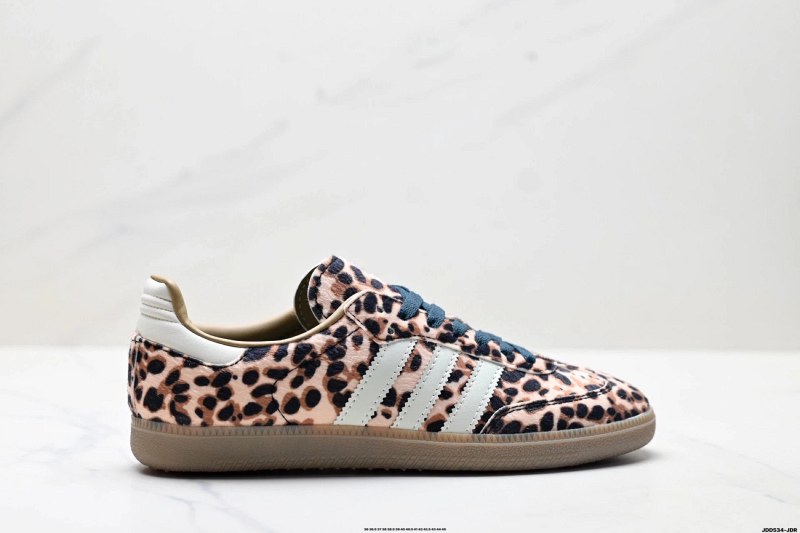
We ordered the Adidas Leopard-Print Sneakers through our agent, paid $31.34 (listed down from $36.37), and put the pair through the desk routine before scoring: more than twenty hours of indoor and Rotterdam street wear, calipers on the sole stack, a steel tape through the insole, a calibrated scale under each shoe and a heat-gun check along the glue lines.
The headline is simple. As a spotted low-top in the Originals Samba mould, this is a lot of shoe for the money. As a piece of product paperwork, it is muddled — an article number that belongs to a different Samba, and two size lists that do not agree.
What the listing actually describes
The catalogue entry is specific about the look: a leopard-print motif across the upper, dark spots on a light ground, white serrated three stripes on the side, a white heel tab, dark laces, a brown gum sole and a low-profile Originals Samba silhouette. Sizes are listed from 35 to 45. The SKU is 7702191943 and the item is shown in stock.
What the listing does not say is what the upper is made of. At $31.34 you should assume a printed synthetic or textile rather than genuine pony hair unless the agent confirms otherwise in writing — the retail leopard Samba OG pairs use a hair-on leather upper and cost roughly three times as much.
Bench numbers
Our sample was a size 42. Measurements are ours, taken in the studio; the listing carries no dimensional data at all, and its weight field reads 0.00, which is worth remembering when you estimate shipping.
| Check | Our measurement | Listing figure |
|---|---|---|
| Weight, per shoe | 374 g | Not stated (0.00 in the listing) |
| Insole length | 27.3 cm | Not listed |
| Insole width at the ball | 9.6 cm | Not listed |
| Heel stack | 2.5 cm | Not listed |
| Forefoot stack | 1.5 cm | Not listed |
| Price paid | $31.34 | $31.34, from $36.37 |
Against the two other $30–$40 low-tops on the table that week, this pair was the lightest and had the stiffest heel counter, which is typical of the Samba shape rather than a fault. The 10 mm drop between heel and forefoot is more than the flat profile suggests from a photo, and it is the reason the shoe reads slightly dressier on foot than a canvas low-top.
Print, panels and build
The print is the part that surprised us. Spots run across the quarter and toe without an obvious break at the panel seams, and none of the repeat edges landed in a place that looked accidental. The white serrated stripes are cut cleanly, the heel tab is stitched straight and the gum outsole colour is even from heel to toe. Under the heat gun, the toe-bumper glue line stayed put with no lifting.
Two things to be realistic about. First, print registration on a cheap pair is a lottery at the margins: check the toe box and the heel in warehouse QC photos, because that is where a shifted pattern shows. Second, a printed surface will scuff differently from leather — there is no polish-and-revive step here, so keep the pair away from kerbs and bike pedals.
The article number points somewhere else
The listing's own spec text carries article number IH9052. Our checks put that code on the black Samba OG Rhinestone: adidas' own product page, plus several retailers, list IH9052 as a Core Black/Cloud White women's Samba OG with a rhinestone upper. Leopard-print Samba OG listings we checked carry a different code, KI6674, in a Magic Beige/Ivory/Gum colourway.
This does not mean the shoes in the photos are wrong. The images and description clearly show a spotted low-top. It means the article number cannot be used as authentication shorthand here, and any buyer planning to compare the pair against a retail release needs to raise it with the agent before paying.
The number is paperwork, not proof. Judge the pair on the photos, the QC set and the measurements — not on a code that also appears on a rhinestone Samba.
The same caution applies to production-origin talk. In community threads, Samba buyers compare "Made in" labels and printed US sizes and sometimes read a mismatch as a red flag; replies point out that men's/unisex and women's versions of the same model naturally carry different US numbers. Use origin and size printing as a prompt for a second look, never as a verdict on their own.
Sizing, and the two size lists
Samba-line guidance is consistent: narrow feet can take their usual size, normal-to-wide feet should go half a size up, and the upper feels snug out of the box before it gives. Our size 42 behaved exactly that way — tight across the instep for the first two wears, comfortable by the fifth, with no heel slip after lacing.
The complication is the listing itself. One line runs 36 to 45 with half sizes; a later spec line runs 35 to 45. Both stop at 45, so 36–45 is the overlap you can order with confidence. Anything at the edges — a 35, or a half size near the top of the run — needs confirming against live stock.
What we would ask the agent before paying
- Which article number ships with the pair, and does the box label match the shoe?
- Is the upper printed synthetic, textile or hair-on, and does the QC photo show the toe and heel pattern?
- What is the packed weight? The listing's 0.00 figure will not help your shipping quote.
- Is your exact size — including half sizes at either end — in stock today?
Answer those four and the rest is straightforward. The shoe itself is a good-looking, light, low-profile leopard low-top that photographs well and wears like the Samba it imitates. It scores 4 out of 5 on our five-point scale, held back by the paperwork rather than the product.
How we tested
Each pair is worn for 20+ hours indoors and on Rotterdam streets before scoring. We measured sole stack with calipers, ran a steel tape through the insole, weighed each shoe on a calibrated scale and compared it with two $30–$40 low-tops from the same haul. Fixed camera angles keep later retests comparable.
Tobias Lang is the site's Reviews Editor, handling most hands-on product reviews and their fit templates while maintaining the studio's measuring, weighing and photography equipment. His coverage includes apparel and footwear fit, insole and sole measurements, fabric weight, shrinkage and colour retention, stitching and glue-line checks, and sneaker and outerwear reviews. Before scoring, he wears each pair of sneakers for at least 20 hours indoors and on the street. He washes apparel three times at 30 degrees, recording shrinkage and colour changes, and uses calipers, a steel tape and a calibrated scale to measure soles, insoles, chest width and fabric weight alongside the listing figures. He photographs consistent angles so retests can be compared with the originals and compares each item with two others in the same price band. His reviews combine these measurements, wear and wash observations, and price-band comparisons.
Do these leopard-print Samba-style sneakers run true to size?
Samba-line guidance says narrow feet can take their usual size, while normal-to-wide feet go half a size up; the upper feels snug at first and loosens with wear. Our size 42 followed that pattern, but confirm your exact size is in stock, since the listing shows two size ranges.
What does the article number IH9052 refer to?
Retail pages carrying IH9052 describe the black Samba OG Rhinestone, not a leopard-print pair. Leopard Samba OG listings we checked use KI6674. Ask the agent which code ships and compare the QC photos with the listing images before paying.
Why are there two size ranges on the listing?
One line reads 36–45 including half sizes, while a later spec line reads 35–45. Both stop at 45, so treat 36–45 as the safe overlap and have the agent confirm any size at the edges of the run.
Sources and notes
- Catalog product page
Product listing verified on 2026-10-25.